
Bay Leaf and Star Anise: Sourcing for a Private-Label Spice Tin
By the Silk Foods Ceylon Editorial Team
Buyer’s snapshot
- Star anise is not grown in Sri Lanka. It arrives on a National Plant Quarantine Service import permit, sourced almost entirely from Vietnam and China, the two countries that supply the large majority of the world’s crop.
- The US Food and Drug Administration warned in 2003 that toxic Japanese star anise (Illicium anisatum) had turned up mixed into consignments sold as the culinary species, linked to seizures in infants.
- Bay leaf sold under one name in Sri Lanka can be three different plants: true Laurus nobilis, Indian Cinnamomum tamala (tej patta), or a locally sold cinnamon leaf, and the label has to say which.
- Gazette 2494/47 requires the printed common name to match what a food actually is and bans a misleading description, so a tin’s species labelling is a compliance line item, not a design choice.
- Silk Foods Ceylon (SFC) private labels whole-spice SKUs from a 50 kg per-SKU raw-material entry tier under BRCGS and FSSC 22000 V6.
Cinnamon, pepper and cardamom carry a Ceylon story because Sri Lanka grows them. Bay leaf and star anise do not get that story, and a private-label range built around them has to be sold on something else: a documented species, a clean import chain, and a tin that keeps the aroma in. Both spices are common enough that buyers assume the sourcing is simple. It is not, and the two ways it goes wrong are different for each one.
Star anise carries an identity risk before it reaches a tin. Bay leaf carries a naming risk that survives to the printed label. A premium whole-spice tin range has to close both, and the packaging format adds a third set of decisions once the spec is settled.
Where the star anise in a Sri Lankan spice tin actually comes from
Star anise, Illicium verum, is native to southern China and northern Vietnam and is not cultivated in Sri Lanka. China accounts for roughly 85 percent of world output, concentrated in Guangxi province, and Vietnam is the second-largest producer, with Lang Son province alone holding around 70 percent of the country’s planted area. A Sri Lankan private-label tin range sources the spice as an import, not a plantation crop, and the two countries above cover most of what reaches a Colombo warehouse.
Imported spice consignments move through Sri Lanka’s National Plant Quarantine Service, which lists spices and dry herbs among the categories requiring an import permit, issued for a three-month validity with a prescribed inspection fee per consignment. That is a plant-health control, not a food-safety species check, which is the gap the next section covers.
For a brand owner writing a spec sheet, the practical takeaway is that origin should be a stated field, not an assumption. “Star anise” on its own says nothing about which of the two dominant supply countries a lot came from, and country of origin is one of the ten declarations a business-to-business import pack must carry under Sri Lanka’s 2026 labelling regulations.
The Japanese star anise risk, and what a goods-in spec catches
The US Food and Drug Administration issued a public advisory on 10 September 2003 after brewed “teas” made from star anise were linked to illness in roughly 40 people, about 15 of them infants, with effects ranging from vomiting and jitteriness to seizures. FDA’s concern was that commercially available Chinese star anise (Illicium verum), a spice generally recognized as safe, had in some consignments been found mixed with Japanese star anise (Illicium anisatum), a related but toxic species traditionally used only for decorative or incense purposes.
The toxicity is real and mechanistically understood. Illicium anisatum contains anisatin, neoanisatin and pseudoanisatin, compounds that act as non-competitive antagonists at GABA receptors in the nervous system, which is why the reported effects in infants centred on the nervous system rather than the gut. FDA’s interim advice at the time was not to consume any tea brewed from star anise until the two species could be reliably told apart in trade.
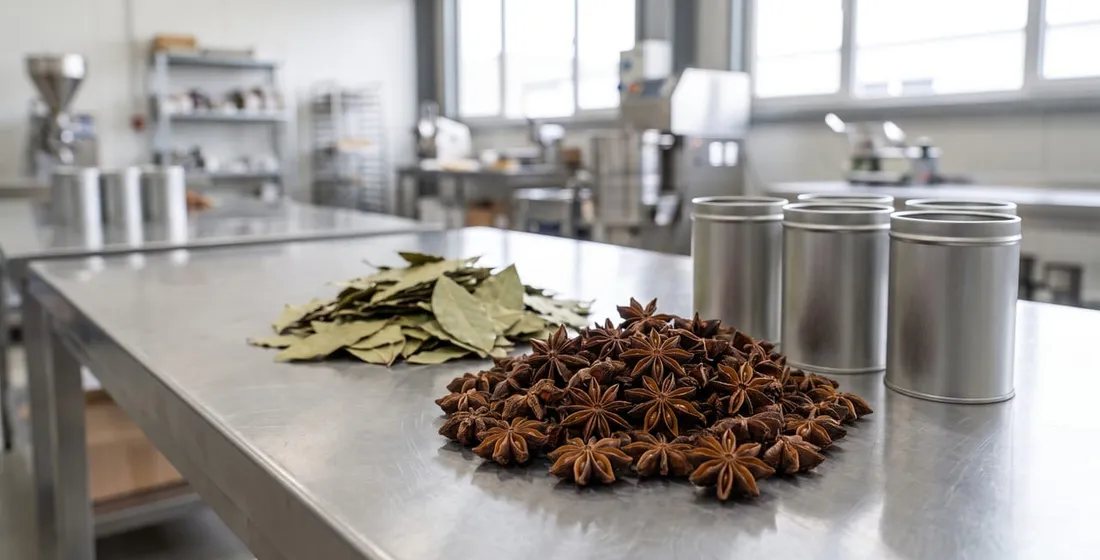
The two species are distinguishable on sight to a trained eye, which is what a goods-in spec is for. ISO 11178:1995, the international specification for star anise, describes the genuine dried fruit of Illicium verum: an eight-pointed, star-shaped, woody, reddish-brown pod with a single glossy brown seed in each carpel. Illicium anisatum pods run paler, thinner-walled and more irregular in the number and shape of their points, without the same glossy seed. A written spec that states the ISO 11178 morphology, checked lot by lot at goods-in against a reference sample rather than taken on trust from a supplier’s paperwork, is the control that keeps an adulterated consignment from reaching a retail tin.
Bay leaf’s naming problem: three plants sold under one common name
“Bay leaf” is not one plant. Three different leaves circulate under names that overlap enough to cause genuine confusion on a spec sheet, and a tin printed with the wrong one is a labelling problem before it is a flavour problem.
Laurus nobilis, the true or Mediterranean bay leaf, is a single-veined, herbal, slightly eucalyptus-scented leaf and the species the international trade specification, ISO 6576:2004, actually covers. Cinnamomum tamala, sold as tej patta or Indian bay leaf, is a different genus entirely, a relative of cassia and cinnamon, with three parallel veins and a warm cinnamon-clove aroma that has nothing in common with Laurus nobilis. A third leaf, sold locally in Sri Lanka simply as cinnamon leaf, is closer botanically to tej patta than to true bay leaf, and none of the three should be substituted for another on a spec sheet or a label even though English-language retail copy sometimes treats them as interchangeable.
The compliance stakes are specific, not general. Regulation 5(1)(a) of the Food (Labelling and Advertising) Regulations 2026, Gazette Extraordinary No. 2494/47, requires the common name to appear in bold on the main panel in the prescribed language combination, and the same regulations define the common name as the name under which a food is commonly identified. Regulation 13 separately prohibits any label or advertisement that contains a false claim or misleading description. A tin printed “bay leaf” holding Cinnamomum tamala is not a translation choice. It is a common name that does not match the contents, which is the exact pairing those two provisions were written to catch.
| Leaf | Botanical name | Genus | Leaf character | Correct common name to print |
|---|---|---|---|---|
| True / Mediterranean bay leaf | Laurus nobilis | Laurus | Single vein, herbal, matte olive-green | Bay leaf (or laurel leaf) |
| Indian bay leaf | Cinnamomum tamala | Cinnamomum | Three parallel veins, cinnamon-clove aroma | Indian bay leaf / tej patta, never plain “bay leaf” |
| Locally sold cinnamon leaf | Cinnamomum spp. (cassia relative) | Cinnamomum | Similar vein pattern to tej patta, milder aroma | Cinnamon leaf, not bay leaf |
Mace, the lacy covering around the nutmeg seed, is the other spice that sits close to this range but is not the subject of it: SFC’s sourcing and grading for mace is covered in full in the guide to nutmeg, mace and vanilla for a premium private-label spice line, and a tin programme adding mace should start there rather than repeat the grading detail here.
Tin packaging for whole spices: what the format actually has to control
A metal tin is chosen for a premium spice SKU for reasons that are functional before they are aesthetic, and each one is a spec decision rather than a look. Getting the four wrong turns a premium format into an expensive way to lose aroma.
Moisture control is the first constraint. Whole star anise pods and bay leaves are hygroscopic, and a tin with a poorly sealed lid or no desiccant strategy lets ambient humidity soften the pods and dull the leaf’s aroma over a retail shelf life. Aroma and volatile-oil retention is the second, and the reason a tin outperforms a kraft pouch in the first place: metal is a near-total barrier to the essential oils that pouches slowly let diffuse out through the film, which matters more for star anise’s anethole content than for most spices on a supermarket shelf.
Liner and headspace design is the third constraint, and the one most often skipped on a first tin run. An uncoated tin interior risks metallic taint against volatile-oil-rich spices, so an inert liner or coating matters, and it has to meet the same food-contact standard as any other packaging component. The Food (Packaging Materials and Articles) Regulations, Gazette Extraordinary No. 1660/30 of 2010, require that food packaging bear a FOR FOOD USE marking or equivalent symbol and that the packaging manufacturer certify the material as food grade, a certification that has to extend to the liner and not stop at the outer metal. Headspace, the air gap left above the fill, needs to be minimised without crushing whole pods, since excess headspace accelerates aroma loss through oxidation even inside a sealed tin.
Fill weight accuracy is the fourth. Whole star anise pods and dried bay leaves are irregular and low-density, so a volumetric fill line calibrated on a powder does not translate directly, and a tin range needs its own fill-weight verification pass. Tin format is not in SFC’s standard packaging list and runs as a custom-packaging engagement inside a private-label build, where fill-weight and liner testing are scoped against the specific tin supplier before the first production run.
| Consideration | Tin | Kraft pouch |
|---|---|---|
| Moisture and aroma barrier | Near-total, if the seal and liner are correct | Moderate, depends on film laminate |
| Shelf presentation | Reusable, premium retail feel | Lower unit cost, less shelf standout |
| Fill-weight consistency for whole pods | Needs its own calibration pass | Same challenge, established on SFC’s standard line |
| Packaging category at SFC | Custom-packaging engagement | Standard format: 50 g to 1 kg kraft pouches |
| Typical use case | Gift-tier and premium private-label SKUs | Volume retail and e-commerce tiers |
A goods-in inspector on a recent whole-spice intake found a supplier consignment labelled star anise where several pods in a sample scoop showed the thinner walls and irregular point count the spec flags as a fail condition rather than natural variation. The lot was quarantined and re-sampled against the ISO 11178 reference description, the kind of hold a documented spec makes routine rather than a one-off judgment call.
Frequently asked questions
Is star anise grown in Sri Lanka?
No. Star anise (Illicium verum) is not a Sri Lankan crop. It is imported, mainly from Vietnam and China, which together supply the large majority of world output, and it enters the country on a National Plant Quarantine Service import permit rather than through local cultivation.
What is the risk with Japanese star anise?
The US FDA warned in 2003 that toxic Illicium anisatum (Japanese star anise) had been found mixed into consignments sold as the culinary Illicium verum species, linked to neurological effects including seizures in roughly 15 infants among about 40 reported cases.
Why does bay leaf need a specific botanical name on the label?
Because three different leaves are sold under overlapping names: true Laurus nobilis, Cinnamomum tamala (tej patta), and a locally sold cinnamon leaf. Gazette 2494/47 requires the printed common name to match what the food actually is and bans a misleading description under Regulation 13.
Does SFC private label a whole-spice tin range?
Yes. Silk Foods Ceylon (SFC) private labels whole-spice SKUs from a 50 kg per-SKU raw-material entry tier, with volume tiers at 500 kg, 1,000 kg and 2,500 kg. Tin format runs as a custom-packaging engagement scoped alongside the standard kraft-pouch range.
Can SFC verify the species of an imported spice before packing?
SFC checks incoming whole-spice lots against a written morphological spec, such as the ISO 11178 description for star anise, at goods-in before a consignment is released to the packing line, under the facility’s BRCGS and FSSC 22000 V6 audit chain.
A tin range built on a documented species spec and a compliant common name sits alongside SFC’s other single-origin spice work, including the grading detail in black pepper grades for a private-label spice line and cardamom grading for a private-label spice line. Buyers building a spec-driven blend rather than a single-origin tin can follow the same approach in a spec for an export-ready ginger and turmeric blend, and a wider portfolio view sits in the private-label spice blend range for distributors. Buyers weighing tin against a lower-cost entry format can compare it with SFC’s 50 g and 100 g spice pouch tier for e-commerce, and the full spice and herb co-packing scope is summarised in SFC’s spice and herb co-packing capability one-pager.
How Silk Foods Ceylon can help
For founders and brand owners building a premium whole-spice tin range, Silk Foods Ceylon (SFC) private labels spice and herb SKUs from a 50 kg per-SKU raw-material entry tier, with volume tiers at 500 kg, 1,000 kg and 2,500 kg as a programme scales. The spice line runs at 100 to 200 kg per hour, and every incoming lot is checked at goods-in against a written spec, including morphological identification for species-sensitive imports such as star anise, before it reaches the packing floor.
Tin is not part of SFC’s standard packaging list, which runs kraft pouches from 50 g to 1 kg by default, so a tin SKU is scoped as a custom-packaging engagement: liner food-contact certification, fill-weight calibration for whole pods and leaves, and label copy checked against the 2026 labelling regulations before artwork goes to print. The Matale facility runs under BRCGS and FSSC 22000 V6, with SLSI submission support built in; treat any SLSI turnaround figure quoted informally as SFC’s own planning assumption, since SLSI does not publish a fixed processing time.
To brief a private-label spice tin project, email b2b@esilkroute.com.lk or call +94 76 441 0389 or +94 76 918 5744.
Sources
- Department of Government Printing, Sri Lanka. Gazette of the Democratic Socialist Republic of Sri Lanka Extraordinary No. 2494/47, Food (Labelling and Advertising) Regulations 2026, 26 June 2026. http://eohfs.health.gov.lk/food/images/2494-47_E.pdf (retrieved 17 September 2026)
- Department of Government Printing, Sri Lanka. Gazette Extraordinary No. 1660/30, Food (Packaging Materials and Articles) Regulations 2010, 29 June 2010. http://eohfs.health.gov.lk/food/images/pdf/regulations/food_packaging_materials_and_articles_regulation_2010_en.pdf (retrieved 17 September 2026)
- Department of Agriculture, Sri Lanka. National Plant Quarantine Service, Import Guideline. https://doa.gov.lk/npqs-import-guideline/ (retrieved 17 September 2026)
- US Food and Drug Administration. FDA Advisory: Do Not Consume Star Anise Tea, 10 September 2003 (Center for Food Safety and Applied Nutrition enforcement story archive). https://www.fda.gov/inspections-compliance-enforcement-and-criminal-investigations/enforcement-story-archive/center-food-safety-and-applied-nutrition-2003 (retrieved 17 September 2026)
- International Organization for Standardization. ISO 11178:1995, Star anise (Illicium verum Hook. f.), Specification. https://www.iso.org/standard/19183.html (retrieved 17 September 2026)
- International Organization for Standardization. ISO 6576:2004, Laurel (Laurus nobilis L.), Whole and ground leaves, Specification. https://www.iso.org/standard/39016.html (retrieved 17 September 2026)
- Sri Lanka Export Development Board. Sri Lanka Spices, Essential Oils and Oleoresins: Export Performance. https://www.srilankabusiness.com/spices/about/export-performance.html (retrieved 17 September 2026)